
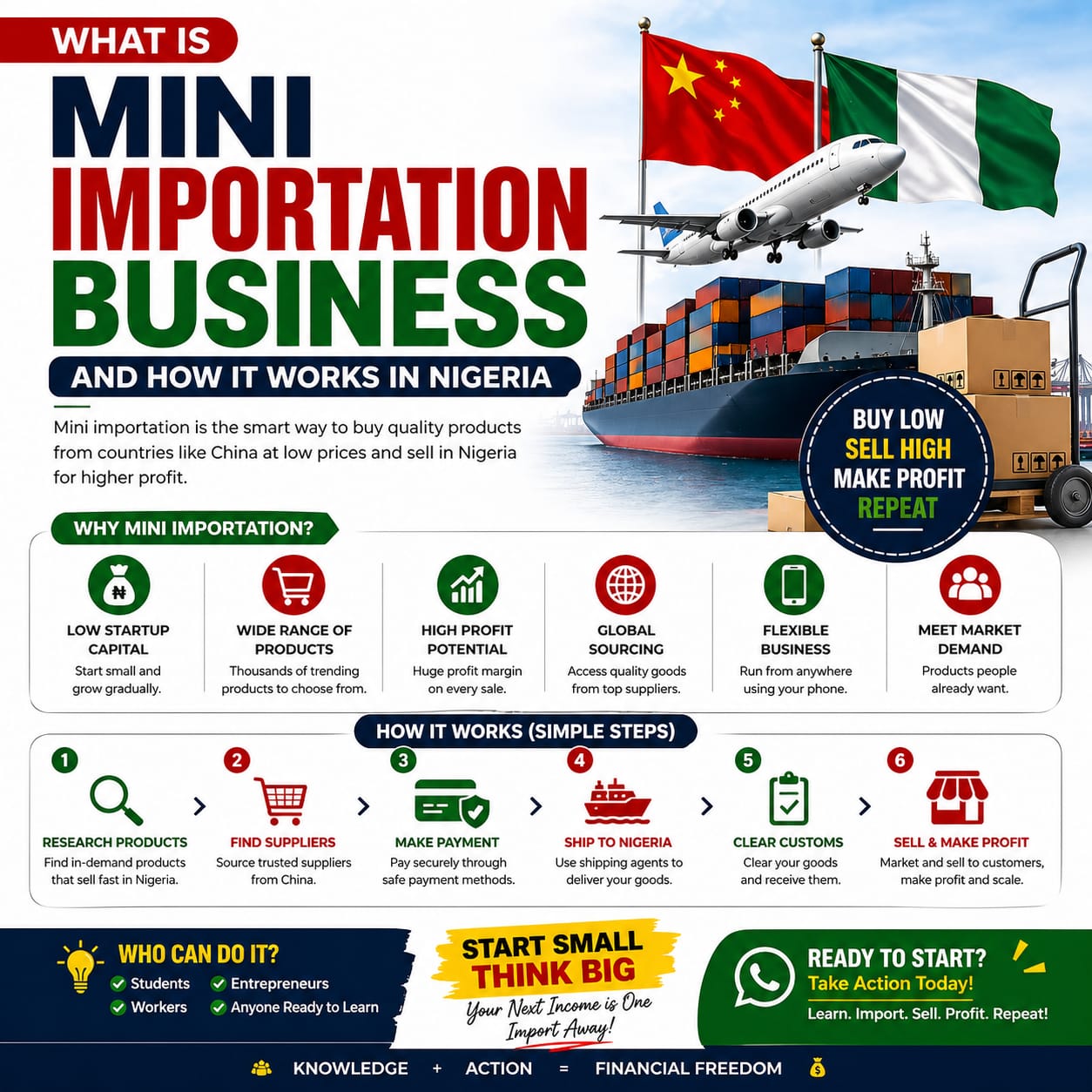
What is Mini and How It Work in Nigeria
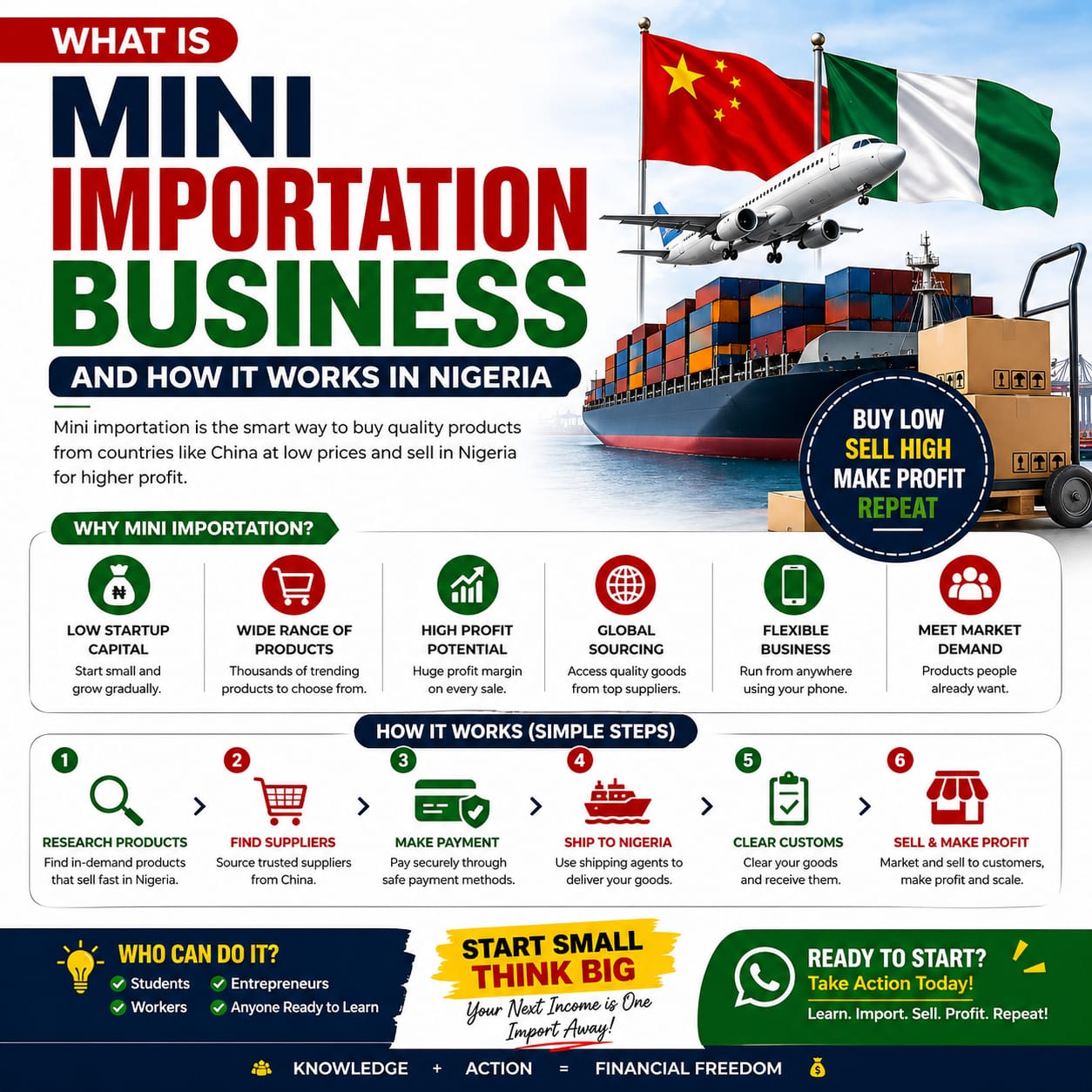
Mini importation business has become one of the most talked-about business opportunities in Nigeria, especially among young people looking for a way to earn daily or weekly income without needing millions of naira to start. It is a business model that allows individuals to buy products from countries like China, Turkey, the UK, or the USA at cheaper prices and resell them in Nigeria for profit. Among all these countries, China remains the most popular source because products are affordable, available in large quantities, and easy to access through online platforms.
The idea behind mini importation is simple. You buy low and sell high. Instead of depending only on local markets where products may already be expensive, importers go directly to the source where manufacturing happens. This helps them get better prices and higher profit margins. The business is called “mini” because you do not need to import a full container before you can start. Even with a small budget, you can buy products in smaller quantities and still make good returns
Many Nigerians first hear about mini importation through social media, YouTube videos, or online business communities. Some people think it is too complicated or meant only for experts, but the truth is that it is one of the easiest business models to understand once the process is explained properly. The challenge is not the business itself, but lack of accurate information. Many beginners jump in without understanding how sourcing, shipping, payment, and selling work, and that is where mistakes happen.
Mini importation works because there is a strong difference between the buying price in China and the selling price in Nigeria. A product that costs ₦2,000 in China may sell for ₦8,000 or more in Nigeria depending on demand, packaging, and marketing. This price difference is where profit comes from. Smart importers understand this gap and use it to build a consistent business.
One of the biggest advantages of mini importation is flexibility. You do not need a physical shop to start. Many people begin from their phones using WhatsApp, Instagram, Facebook Marketplace, TikTok, or Telegram. They order products, receive them, advertise online, and sell directly to customers. This makes it attractive for students, side hustlers, salary earners, and full-time entrepreneurs.
To understand how mini importation works, the first thing to know is product selection. Every successful importer starts by choosing what to import. This decision is very important because the wrong product can tie down your money for months. Good products are usually lightweight, easy to ship, affordable, and in high demand. Examples include fashion accessories, phone gadgets, kitchen tools, beauty products, wristwatches, sneakers, and home accessories.
The Nigerian market responds strongly to products that solve simple daily problems or improve lifestyle. For example, rechargeable gadgets, smart kitchen tools, and beauty devices often sell fast because people see immediate value in them. Successful importers do not just choose products because they personally like them—they choose based on what people are already willing to pay for.
Research is a major part of this stage. Before importing, smart business owners study trends. They check what is selling on Jumia, Konga, Instagram stores, and even local markets. They observe Facebook ads and TikTok trends. If many sellers are promoting the same type of product, it often means there is demand. The goal is not to guess but to follow market behavior.
After choosing the product, the next stage is finding a supplier. This is where China comes in strongly. Platforms like Alibaba, AliExpress, 1688, and DHgate help Nigerians connect directly with Chinese manufacturers and wholesalers. These websites make it possible to order products without physically traveling to China. You simply search for your product, compare suppliers, and place your order online.
However, not every supplier is trustworthy. This is where many beginners lose money. A good supplier should have strong reviews, clear product photos, transaction history, and responsive communication. Verified suppliers are safer because they have already built some credibility on the platform. Serious importers take time to compare suppliers instead of rushing to buy from the cheapest option.
Negotiation also plays a big role in mini importation. Many beginners do not know that prices on supplier platforms are often negotiable. Chinese suppliers expect bargaining, especially if you are buying more than one unit. Even reducing a product price by a small amount can significantly increase profit when multiplied across many units. Negotiation is not about being difficult—it is part of business.
Once supplier and product details are confirmed, payment comes next. This stage makes many Nigerians nervous because it involves sending money internationally. Some suppliers accept direct bank transfers, while others work with secured systems like Alibaba Trade Assurance. Because of currency restrictions in Nigeria, many importers also use trusted payment agents who help convert naira to dollars or yuan for supplier payments.
Before making payment, proper confirmation is necessary. You must check the supplier’s invoice, confirm bank details, and understand the full order summary. Sending money carelessly is one of the fastest ways to lose in this business. Experienced importers usually start with smaller test orders before increasing quantity. This helps them confirm product quality and supplier reliability before going bigger.
Shipping is the next major stage, and it is one of the most misunderstood parts of mini importation. After payment is completed, goods need to move from China to Nigeria. There are two common methods: air freight and sea freight. Air freight is faster but more expensive, while sea freight is slower but cheaper. Your choice depends on product size, urgency, and budget
For small and fast-moving products, air freight is often the better option because it helps you test the market quickly. For larger quantities or heavy items, sea freight reduces overall cost per unit. Most importers work with shipping agents who handle the logistics from China to Nigeria. These agents collect goods from suppliers, arrange shipping, manage paperwork, and coordinate local delivery.
Shipping agents are very important because they reduce stress. Instead of trying to manage customs and logistics alone, importers rely on agents who understand the process. A good shipping agent can save money, time, and unnecessary problems. That is why finding a trusted agent is almost as important as finding a trusted supplier.
When goods arrive in Nigeria, customs clearance becomes the next step. Customs officers inspect imported goods before releasing them into the country. If documents are complete and products are legal, the process is usually smooth. However, delays can happen because of incomplete paperwork, inspections, or holiday periods.
Some beginners make the mistake of ignoring customs requirements, hoping to “manage it somehow.” This usually leads to stress, penalties, or even seized goods. Serious importers respect customs procedures and work with licensed clearing agents when necessary. Doing things properly protects both the goods and the business.
After clearance, the importer receives the products and prepares for selling. This is where mini importation changes from planning to actual business. Products should be checked immediately for damages, missing items, or quality issues. If there is any problem, it is easier to handle it quickly while details are still fresh.
Packaging also matters a lot. In Nigeria, customers often judge value by presentation. A simple product with good packaging can sell faster than an expensive product with poor presentation. Some importers improve packaging locally to increase perceived value and justify higher pricing. This small detail can make a big difference in profitability.
Selling is where the real income comes in. Today, social media has made selling easier than ever. You can run a profitable mini importation business without renting a shop. WhatsApp status, Instagram reels, Facebook Marketplace, and TikTok videos have become powerful sales channels. The key is visibility and consistency.
Good product pictures, clear captions, and simple explanations help buyers trust your offer. Customers want to know what the product does, how it helps them, and why they should buy from you instead of someone else. Many successful importers focus heavily on trust-building because trust drives conversion more than flashy graphics.
Pricing is another critical part of how mini importation works. Many beginners only calculate product cost and forget shipping, customs, and local delivery expenses. This leads to underpricing and hidden losses. Proper pricing should include every expense from supplier payment to final customer delivery, plus your profit margin.
Profit margins in mini importation vary depending on the product. Some products give 30% profit while others can give over 200%, especially trending items with strong emotional buying power. The goal is not just high profit, but consistent profit. Sustainable business always beats one lucky sale.
Mini importation also teaches discipline because not every product sells immediately. Sometimes products stay longer than expected before customers buy. This is why patient testing is important. Instead of investing all your money into one product, smart importers diversify across multiple items. This reduces risk and improves cash flow.
Another reason mini importation is growing in Nigeria is unemployment and economic pressure. Many people are looking for side income outside salary jobs. Mini importation gives them a practical business they can start small and scale gradually. Some begin with ₦50,000 while others start with ₦500,000 depending on their confidence and product type.
Students use it to support school expenses. Workers use it as a side hustle. Full-time entrepreneurs use it to build long-term income streams. The business fits different lifestyles because it can be adjusted to available time and budget. This flexibility is one reason it keeps growing every year.
However, mini importation is not magic money. It requires patience, research, and consistency. Some people fail because they expect instant wealth. They import blindly, trust fake suppliers, or refuse to learn from mistakes. Like every real business, success comes from understanding systems, not chasing shortcuts.
Scammers also exist in this space, especially on social media. Fake agents, fake suppliers, and fake training programs target beginners who are desperate to start quickly. This is why knowledge matters. The more informed you are, the harder it becomes for someone to deceive you. Education is your first form of protection.
Technology has made the business easier than before. Payment systems are improving, shipping networks are stronger, and supplier access is wider. What used to require international travel can now be done from a smartphone. This opens opportunities for ordinary Nigerians who were previously locked out of global trade.
Branding is another stage where serious importers grow beyond basic buying and selling. Instead of just reselling products, they build identity around them. They package better, create business names, run customer service properly, and turn imported goods into recognizable brands. This creates customer loyalty and repeat sales.
Some importers eventually move from mini importation to full wholesale business. What starts with ten pieces can grow into cartons, then containers. The principles remain the same—source smartly, manage cost, and sell effectively. Growth happens when profits are reinvested wisely instead of spent carelessly.
Mini importation also supports local entrepreneurship because imported goods often create related jobs. Delivery riders, marketers, customer support workers, content creators, and resellers all benefit from one importer’s operations. It becomes bigger than one person—it creates a small ecosystem of economic activity.
The Nigerian market remains strong because consumer demand is constant. People will always buy products that improve comfort, status, beauty, or convenience. Importers who understand consumer psychology do better because they are not just selling products—they are selling solutions and lifestyle improvements.
Trust remains the backbone of long-term success. Customers who trust your business return again and again. Suppliers who trust your consistency offer better deals. Agents who trust your seriousness prioritize your shipments. Mini importation may start with products, but it grows through relationships.
In the end, mini importation business is simply smart buying and smart selling on a global scale. It allows ordinary Nigerians to tap into international supply chains and create local profit. It is practical, scalable, and realistic for those willing to learn.
Understanding how it works removes fear. Once the mystery disappears, the business becomes clearer. Product selection, supplier sourcing, payment, shipping, customs, and selling are not impossible steps—they are learnable systems. Anyone who studies them properly can participate.
That is why mini importation continues to attract attention across Nigeria. It offers more than profit; it offers independence. For many people, it becomes the first real step into entrepreneurship and financial growth.
Starting small is not a weakness. In fact, it is often the smartest move. Learn the process, protect your capital, test the market, and improve with experience. That is how successful importers are built.
Mini importation is not about luck. It is about information, discipline, and execution. Those who respect the process often discover that what looked like a side hustle can become a serious and sustainable business.